

Mamdani Runs the Table
A look at what the four New York Congressional primaries tell us.

Tuesday night was, as is being broadly reported, a big night for New York City Mayor Zohran Mamdani. Mamdani endorsed three candidates for Congress, Claire Valdez, Brad Lander and Darializa Avila Chevalier. All three of them won. Valdez beat a popular elected official who was considered the front-runner when the race began. Chevalier beat an incumbent who had been in office for a decade.
The Goldman-Lander race was a little different as that district is a progressive district that Goldman won in a multi-candidate race in 2022 where the progresive vote was divided and, due in part to his enormous family wealth, he was able to significantly outspend his opponents. Additionally, candidates backed by Mamdani for the State Senate and Assembly also did quite well throughout the five boroughs.
Mamdani May Be the Mayoral Dog that Finally Caught the Car
It is clear that, at least in New York City, and to some extent nationally, this is now Mamdani’s Democratic Party. Any Democrat who wants to keep giving weapons to Israel and is too timid about taxing the wealthiest Americans is now, and not just in New York, in danger of losing a primary. Mamdani and the Democratic Socialists of America (DSA) are a big part of that.
This big victory also raises a few challenges for Mamdani. The first is specific to the race in the Seventh Congressional District where Valdez drubbed Reynoso. Unlike the other races where Mamdani-backed candidates for Congress defeated more centrist incumbents, this one more or less pitted two progressives against each other. Valdez was supported by Mamdani and the DSA and Reynoso was not.
Reynoso was the candidate of Nydia Velazquez the longtime congresswoman from that district and a progressive stalwart. Velazquez had endorsed Mamdani in his race for Mayor a year ago at a time when Mamdani badly needed Latino support. Mamdani repaid Velazquez by backing somebody against Reynoso in a race where the ideological differences between the candidates were not very significant. In doing that successfully Mamdani demonstrated his political strength. However, the Mayor also violated one of the first rules of politics-dance with the one that brung ya.
The political community now understands that Mamdani cannot be depended upon to take care of people who help him. Many of his supporters will point to that as evidence of him being a different kind of politician. That is certainly true, but it is also true that a member of the City Council, state assembly or anybody else will think twice about making a politically risky deal with Mamdani knowing that the Mayor’s future support might be withheld if a good DSA candidate comes along. That will make Mamdani’s job a bit tougher going forward.
It is nonetheless the case that between the election and the Knicks championship, which put Mamdani in the media spotlight in a very positive way, this has been an excellent few weeks for the mayor. Mamdani has greater political influence and now must figure out what to do with it. Brad Lander cannot help him get a bill through the City Council. Claire Valdez cannot help him balance the budget and Darializa Avila Chevalier, despite having some good ideas on housing, is not in a position to help Mamdani turn those into reality.
Mamdani now must return to the relatively boring work of governance. Six months and one NBA championship into his mayoralty, he now must deliver on affordability, rent freezes, free public transportation and childcare. He also needs to refine other ideas consistent with his vision and turn those into law. That will be very difficult, but it is also not entirely obvious that Mamdani is more interested in that than in social media and politics. The Mayor has clearly done extremely well in those areas, but he now must choose between continuing to make his mayoralty about his own popularity and political movement or producing more tangible results for New Yorkers.
The New Electoral Cleavages in New York
If you, like me, have spent most of your life in and around the American left, especially if you are forty or older, you have heard the basic orthodoxy of progressive politics-that the coalition begins with working class people of color. That was always good rhetoric, but also a more problematic presumption than many wanted to recognize. One of the keys to the success of the DSA left, particularly in New York this year and last year, has been they no longer even pretend to hew to that orthodoxy.
During the campaign here in the 13th Congressional District where I live, the incumbent Adriano Espaillat, on his way to a humiliating defeat, attacked his opponent by accusing her of being a gentrifier. The attack was not sufficiently effective but was true to the extent that the coalition that unseated Espaillat and that defeated Antonio Reynoso in Brooklyn was one that in most cases would be understood as gentrifiers.
There is no good exit poll data from these races, but the New York Times reported some neighborhood based data that tells a very clear story. In NY-7, Valdez won areas where voters were younger, more likely to have college degrees or higher income by margins of over 2-1. Reynoso won lower income areas and majority Black neighborhoods by similar or greater margins. Valdez managed to win majority Latino neighborhoods by a 19 point margin.
In NY-13, located in Northern Manhattan, the numbers were perhaps more stark. Avila Chevalier won areas where residents were younger by 24 points, college educated by 19 points and higher income by only 6 points, while Espaillat won lower income, majority Latino areas while the two candidates were virtually tied in majority Black areas.
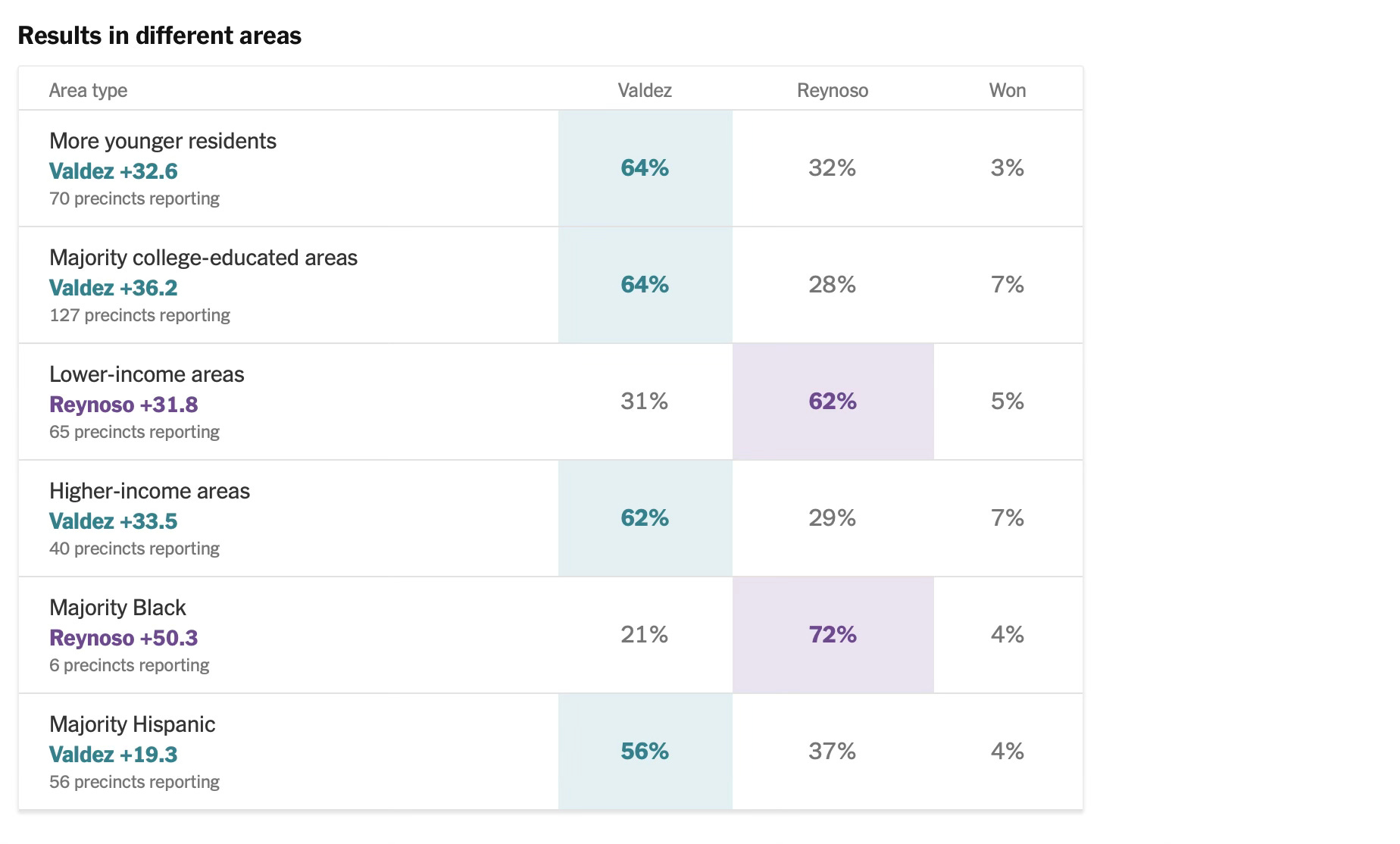
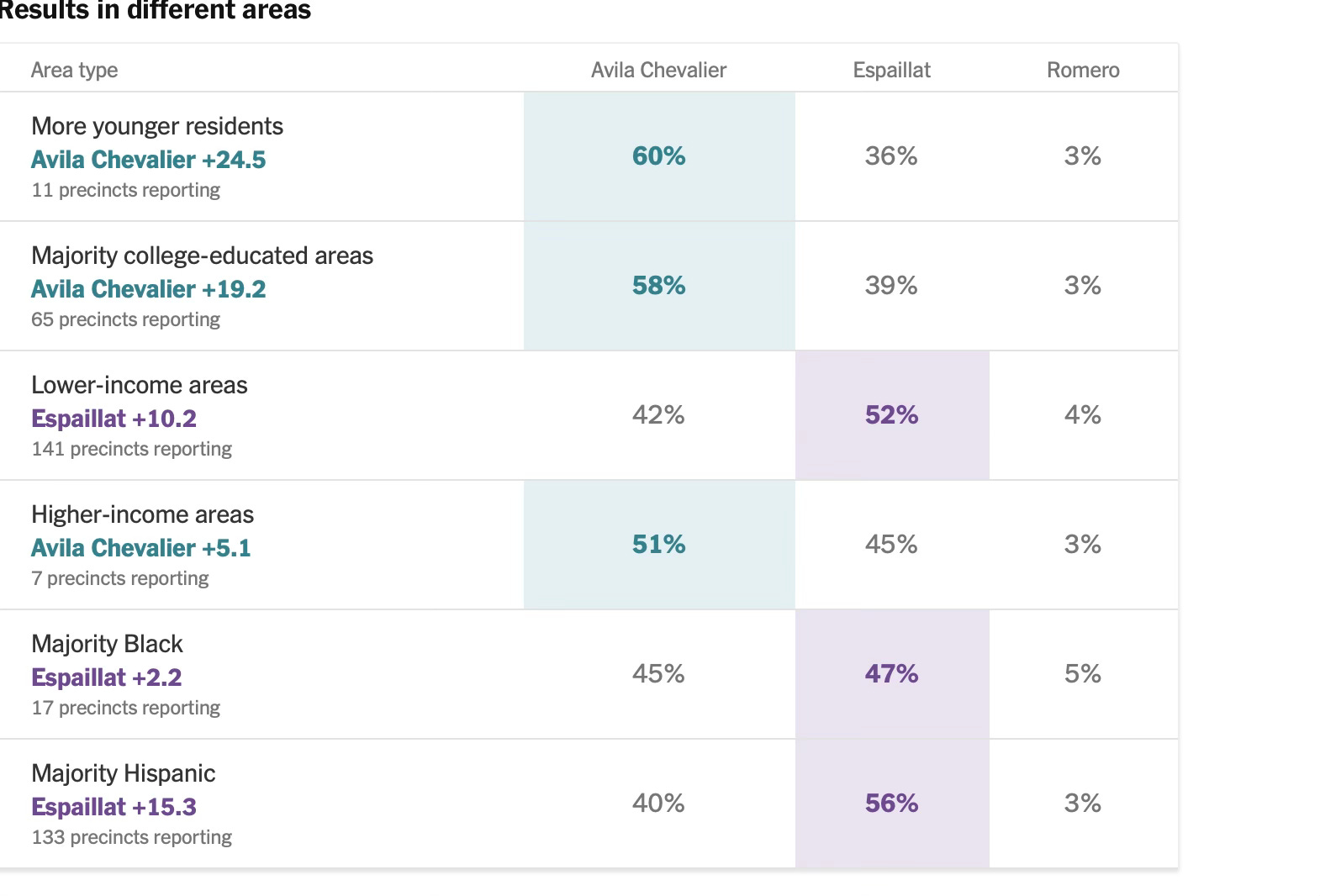
This kind of data is not always entirely accurate, but it provides a good overview and, in this case, paints a clear picture. In both these districts the younger, whiter, better educated and wealthier resident went with Mamdani’s candidate. Given those voters were Mamdani’s base in last year’s primary, that is not a big surprise, but it may tell us something about where, and for whom, Mamdani’s mayoralty may be heading.
The Mayor’s younger more educated base may be worried about affordability, but they are not poor. These are not voters who do not have a direct stake things like fixing public housing or expanding social welfare programs and the like, but have an ideological commitment to a more fair economic system. Meeting the needs of this precariat, rather than the proletariat, is now the task facing our socialist mayor.
Creating affordable middle-class housing, expanding childcare programs and healthcare programs, making public transportation cheaper are all important parts of that agenda and all areas where Mamdani will find himself, with no election approaching, under increasing pressure to deliver.
The National Media Gets It Wrong
The race in the New York’s 12th Congressional District, which includes much of the Upper West and Upper East Sides, drew perhaps the most national attention. This was a race that pitted the man who going to take on AI against 21stCentury Camelot against the Lincoln Project warrior who had the secret formula to impeach and remove Donald Trump.
Oh, and there was another candidate in the race. The national media all but dismissed him as some nebbishy Jewish guy from the Upper West Side. The national media may have framed it that way, but the voters looked at the Upper West Side candidate and saw somebody who had a deep understanding of governance and legislation, strong roots in the community and, while certainly no radical, a commitment to liberal ideals and this city that he sometimes referred to as the New York project.
It should also be mentioned that in a year where much of the Democratic Party sees Zionism as the worst ideology since Naziism, Lasher ran as a liberal/left Zionist and made it clear he would never turn a blind eye to antisemitism.
By 10:30PM on election night, to the surprise of nobody who understood New York City politics, Micah Lasher was the Democratic nominee from NY-12. Some might attribute Lasher’s victory to the electoral math of being the only West Side candidate and having the backing of several generations of the Democratic establishment, but I am not convinced of that. Lasher won by only four points suggesting that the anger that drove Avila Chevalier, Lander and Valdez to their victory was lurking in the 12th district too, but was not quite as strong there.
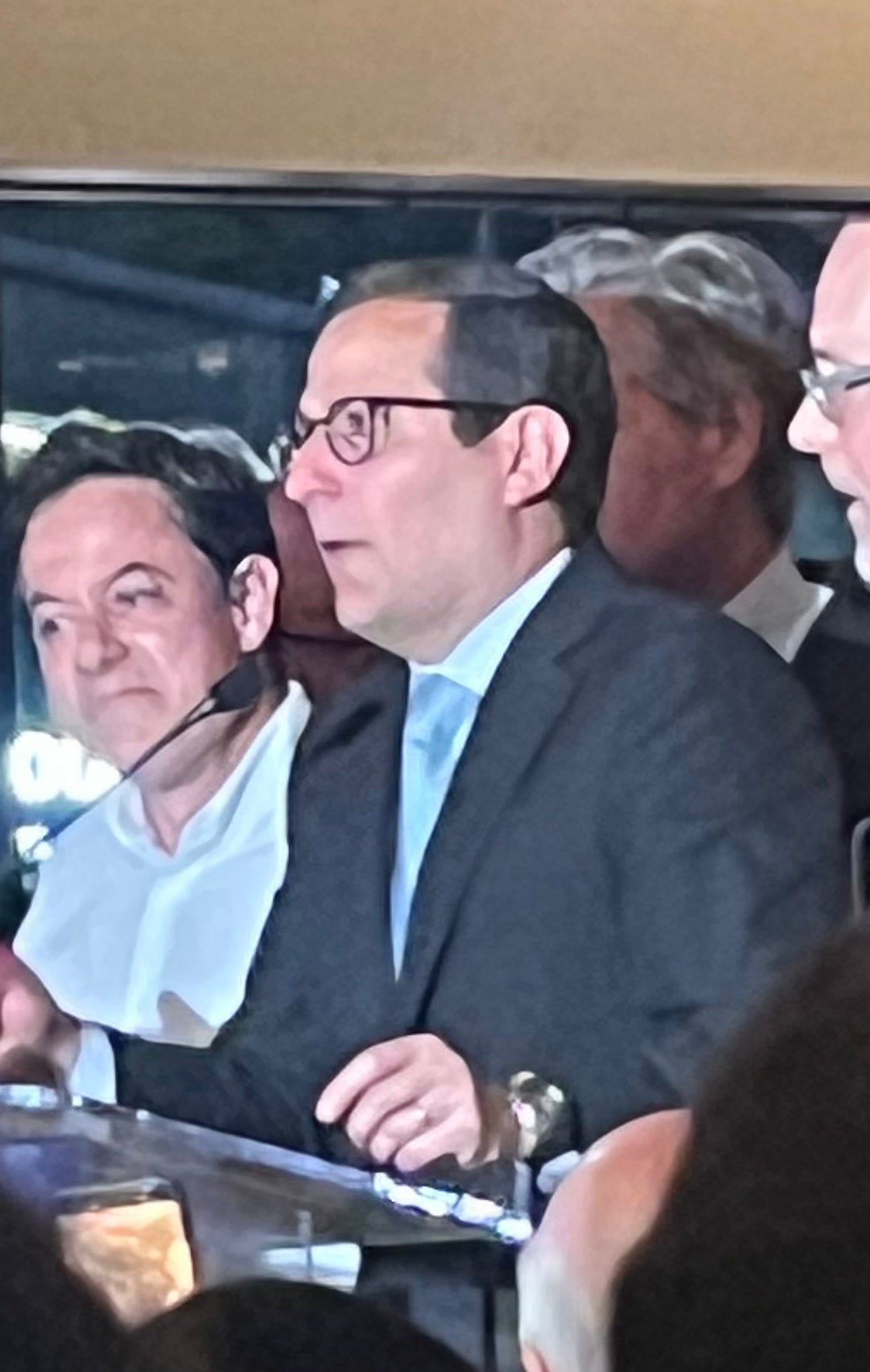
All that support would not have been enough to secure victory for a lesser candidate. It was only because Lasher ran a strong campaign, had extremely deep ties to the community, proved himself an able debater and once again demonstrated that he is an excellent political tactician that he was able to win. The smart, aggressive and like Lasher, handsomely funded, campaign that Alex Bores, who came in second, would have been successful against a candidate with fewer skills and less political experience.
Bores’s campaign ultimately faltered on its own internal contradictions. Turns out that despite the shamless kvelling over Bores by the likes of Ezra Klein, whose own relationship to big tech is worth exploring more, he did not quite overcome the reluctance among voters to believe Bores quit Palantir before it turned evil or to overlook the reality that Bores’s campaign was funded heavily by AI and crypto interests.
Lasher also won in part because he if you ran into him on Mount Everest or the Sahara Desert, your first thought would be “I bet that guy is from the Upper West Side of Manhattan.” He is a product of community that turns out in huge numbers in Democratic primaries, and that was essential to his victory. Lasher’s victory speech was laden with mentions of West Side landmarks, befitting his life and political background, but to secure his political future and preclude a challenge from an East Side candidate in 2028, he must deepen his ties to that part of town as well as the more southern parts of the district. This should not be difficult as Lasher is temperamentally and politically a good East Side fit, but he must do the work. I suspect he will.
Lander Goes to Congress
The race for Congress in New York’s Tenth Congressional District which includes much of lower Manhattan and parts of northern of Brooklyn was over pretty much as soon as Lander entered the race. In the end, Lander drubbed incumbent Dan Goldman in the primary by a margin of 69-35. This was expected in large part because NY-10 had is a progressive district that Goldman only won in 2022 because his 25.8% of the vote was enough against a divided progressive field. Once Lander entered the race and cleared the field, Goldman had almost no chance.
Ten years ago, Goldman, Lander and Lasher’s current views on the Middle East would have put them all on the left side of Democratic and Jewish politics. Today, Lander still represents that faction while Goldman and Lasher, whose views have not changed all that much, are considered by many on the left to be far too conservative when it comes to Israel. That view cost Goldman the election. Lasher, running in a different kind of district, was able to win a close race.
That is how much politics on Israel have changed within the Democratic Party and is a warning to other moderately pro-Israel candidates, but also a sign of how the left has a significant amount of single-issue voters who seem unable to bring themselves to support candidates who think that the State of Israel is not the worst country ever or that October 7th was a bad thing. Anybody vaguely supportive of Israel is now, in those voters’ views, a genocidaire. Despite media focus on affordability, it was his views on Israel that cost Espaillat his seat and provided the energy for those young white voters who came out to vote for Avila Chevalier and Valdez.
Lander is a bit of a different story. There may not be a single Jewish figure in political life of any political significance who has been more supportive of the Palestinian cause, taken as much criticism from within the Jewish community or who was as important to the election of Mamdani as Mayor in 2025. However, Lander is now no longer welcome among parts of the Mamdani coalition because he identifies as a Zionist.
This obsession with purity around the Palestinian cause, unwillingness to wrestle with any complexity around the politics and history of the region, willingness to turn on a good man and committed ally like Lander, ongoing demonization of Israel-and anybody who believes to any extent in a Jewish homeland-is now a pillar of the American left, even if many would rather not recognize that.
Nobody is caught in this trap more than Lander who has a deep and genuine commitment to a new vision for the Middle East but one that is grounded much more in political and historical reality than either the far-right Zionists here and in Israel or the extremes of the Free Gaza movement globally. On the one hand, that puts Lander in a position to be national leader of progressive Jews on issues around Israel on the Middle East.
There is also the possibility that Lander is pushed aside by more radical supporters of the Palestinians because of his views that place him on the far left of the Zionist movement and by many Jews who will accuse him of being a self-hating Jew. For the record, I’ve known Lander for a long time, and he is certainly not a self-hating Jew. Whether Lander becomes an important national figure or the loneliest man in Congress remains to be seen, but I hope he becomes the former.
Mamdani’s New York
Tuesday was the second New York Democratic primary in a year where the big story was Zohran Mamdani. A year ago and this year the Mamdani basically ran the table. The question facing the DSA/Mamdani wing of the Democratic as well as the more Party’s more centrist establishment is where to go from here. The latter must now recognize that candidates who continue to eschew any redistributive economic policies and who veer away from a strong anti-Israel position will be in trouble. Micah Lasher may the highest profile exception to this with regards to Israel, but he is, in many respect, a sui generis politician in a very specific kind of district.
The left-wing of the Party needs to recognize that they are now, in many respects, the Democratic Party against whom they have campaigned for so long. In other words, they the dog that needs to figure out what to do with the car now that they have caught it. How Mamdani, in particular, resolves that challenge will be essential to his, and the DSA’s, future.